For this example I'm going to be using Newton's second law \(F = ma \) where F = force, m = mass and a = acceleration. I'm going to use 6.6743 × 10
I will call the universal gravitation formula equation 1 and the second law formula equation 2.
. The distance between the centres of gravity of m
is d. Combining equations 1 and 2 we get:
So for planet Earth and our nearest neighbours, using the above equation and a mobile phone calculator, I get the following:
First I need to introduce a new equation, the equation for centripetal force. We can call this Equation 3.
due to it's velocity v.
on both sides of the equation cancel out. Rearranging this equation we get:
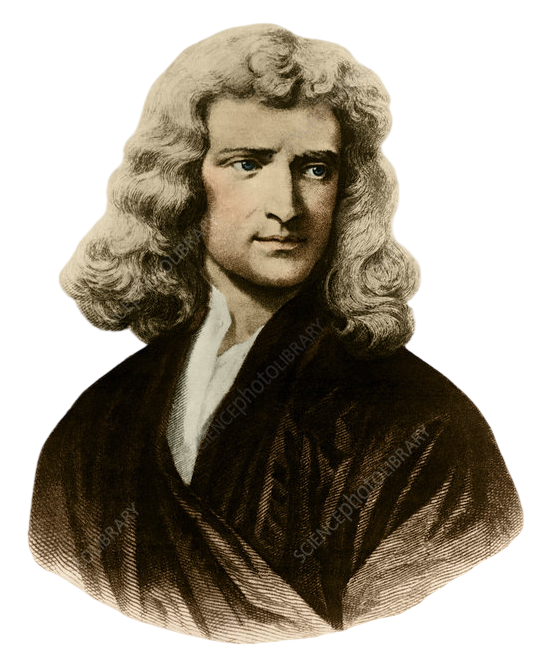
Sir Isaac Newtons
This page is a sort of Sir Isaac Newton tribute. Because of the way my education went, Newton is one of the few great scientists whose work I can understand. Anyone who knows me well knows my great admiration for this genius.
Here's his laws of motion:
1. The Law of Inertia
An object at rest stays at rest, and an object in motion remains in motion at a constant speed in a straight line, unless acted upon by an external unbalanced force.
2. The Law of Force
The acceleration of an object depends directly on the net force acting on it and inversely on its mass.
3. The Law of Action and Reaction
For every action, there is an equal and opposite reaction. When two objects interact, they apply forces to each other of equal magnitude and opposite