Bernoulli's Equation
For Steady State Flow of a Fluid Through a Constriction or Expansion in a Pipe
\(P_1 + {1 \over 2} \rho v_1^2 + \rho g h_1 = P_2 + {1 \over 2} \rho v_2^2 + \rho g h_2\)
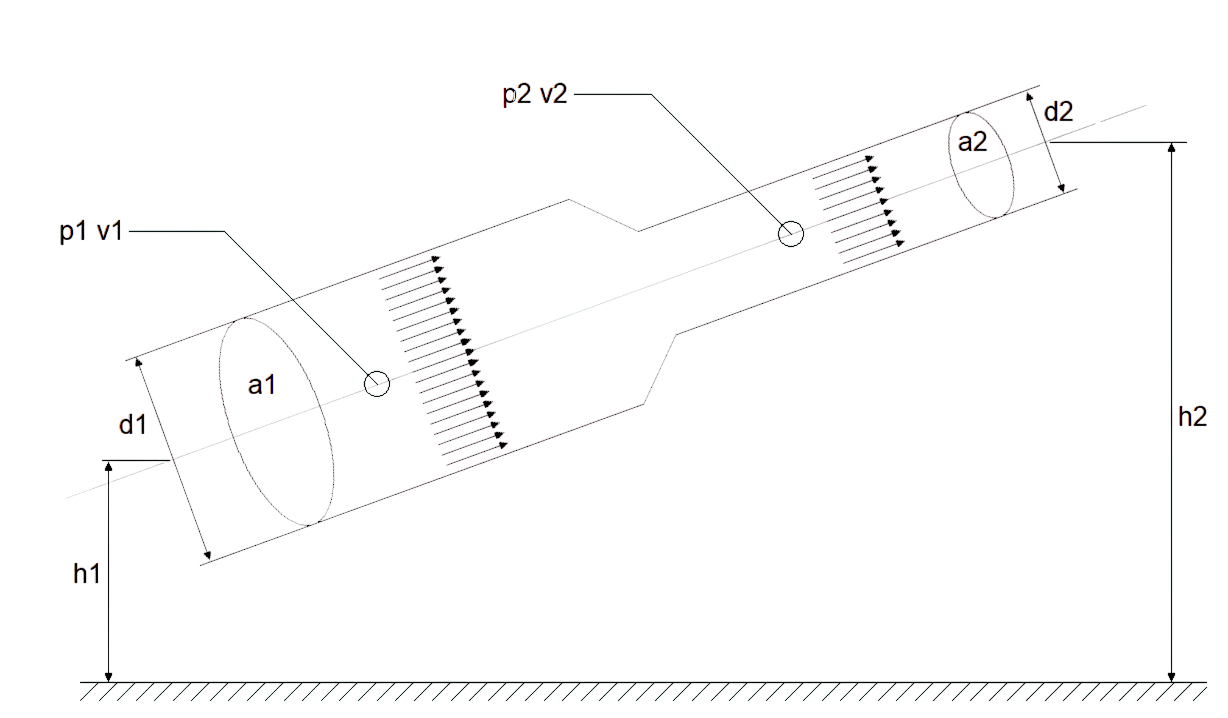
ρ = Fluid density
g = Acceleration due to gravity
h1 = Downstream elevation
p1 = Pressure at elevation h1
v1 = Velocity at elevation h1
h2 = Upstream elevation
P2 = Pressure at elevation h2
v2 = Velocity at elevation h2
This equation assumes that the effects of friction and viscosity are negligible and that density remains constant. If we also assume the usual case of the flow rate Q being constant we can use the continuity equation in its simplest form.
\(Q = v_1a_1 = v_2a_2 \)
Sample Calculation
For a simple calculation example lets assume that the pipe work is horizontal i.e. h1 = h2 and therefore the Bernoulli equation reduces to:
\(P_1 + {1 \over 2} \rho v_1^2 = P_2 + {1 \over 2} \rho v_2^2\) which can be rearranged to \(P_2 = P_1 + {1 \over 2} \rho v_1^2 - {1 \over 2} \rho v_2^2\).
Lets also assume that we know the pressure and flow rate of the fluid entering the pipe work because we know the characteristics of the pump generating the fluid flow. We also know the fluid density so we can add these details to a form.
Density ρ (kg/m3)
Inlet Pressure P1 (bar g)
Flow Rate Q (m3/s)
Lets assume that we are designing the pipe work and we want to change the inlet and outlet diameters and see the resulting velocities and the outlet pressure. so we can add these two variables in the following form.
Inlet Diameter d1 (m)
Outlet Diameter d2 (m)
Calculate
a1 = 0.196 m2
a2 = 0.049 m2
P1 = 0.5 bar g
P2 = 0.014 bar g
v1 = 2.546 m/s
v2 = 10.186 m/s
Bernoulli's Equation
Bernoulli's equation is usually described as a statement of the conservation of energy for fluid flow but in my opinion could also me thought of as the conservation of the ability of a fluid to do work as it passes through a constriction or expansion of a flow path.
The assumptions or approximations for Bernoulli's equation are:
Steady state flow (constant flow rate).
Constant density.
Fluid viscosity is negligible.
Friction effects are negligible.
|
|
\(P_1 + {1 \over 2} \rho v_1^2 + \rho g h_1 = P_2 + {1 \over 2} \rho v_2^2 + \rho g h_2\) ρ = Fluid density g = Acceleration due to gravity h1 = Downstream elevation p1 = Pressure at elevation h1 v1 = Velocity at elevation h1 h2 = Upstream elevation P2 = Pressure at elevation h2 v2 = Velocity at elevation h2 This equation assumes that the effects of friction and viscosity are negligible and that density remains constant. If we also assume the usual case of the flow rate Q being constant we can use the continuity equation in its simplest form. \(Q = v_1a_1 = v_2a_2 \) |
Sample Calculation
For a simple calculation example lets assume that the pipe work is horizontal i.e. h1 = h2 and therefore the Bernoulli equation reduces to:
\(P_1 + {1 \over 2} \rho v_1^2 = P_2 + {1 \over 2} \rho v_2^2\) which can be rearranged to \(P_2 = P_1 + {1 \over 2} \rho v_1^2 - {1 \over 2} \rho v_2^2\).
Lets also assume that we know the pressure and flow rate of the fluid entering the pipe work because we know the characteristics of the pump generating the fluid flow. We also know the fluid density so we can add these details to a form.
Lets assume that we are designing the pipe work and we want to change the inlet and outlet diameters and see the resulting velocities and the outlet pressure. so we can add these two variables in the following form.
Inlet Diameter d1 (m) Outlet Diameter d2 (m)
Calculate
a1 =
0.196 m2
a2 =
0.049 m2
P1 =
0.5 bar g
P2 =
0.014 bar g
v1 =
2.546 m/s
v2 =
10.186 m/s
Bernoulli's Equation
Bernoulli's equation is usually described as a statement of the conservation of energy for fluid flow but in my opinion could also me thought of as the conservation of the ability of a fluid to do work as it passes through a constriction or expansion of a flow path.
The assumptions or approximations for Bernoulli's equation are:
Steady state flow (constant flow rate).
Constant density.
Fluid viscosity is negligible.
Friction effects are negligible.